Xiaomi’s AI Cube prototype packs three Xring chips into a local-AI mini PC
The engineering prototype combines Xring O3, O100 and D100 silicon, promises local 120B-model deployment and sustains up to 150W of performance.
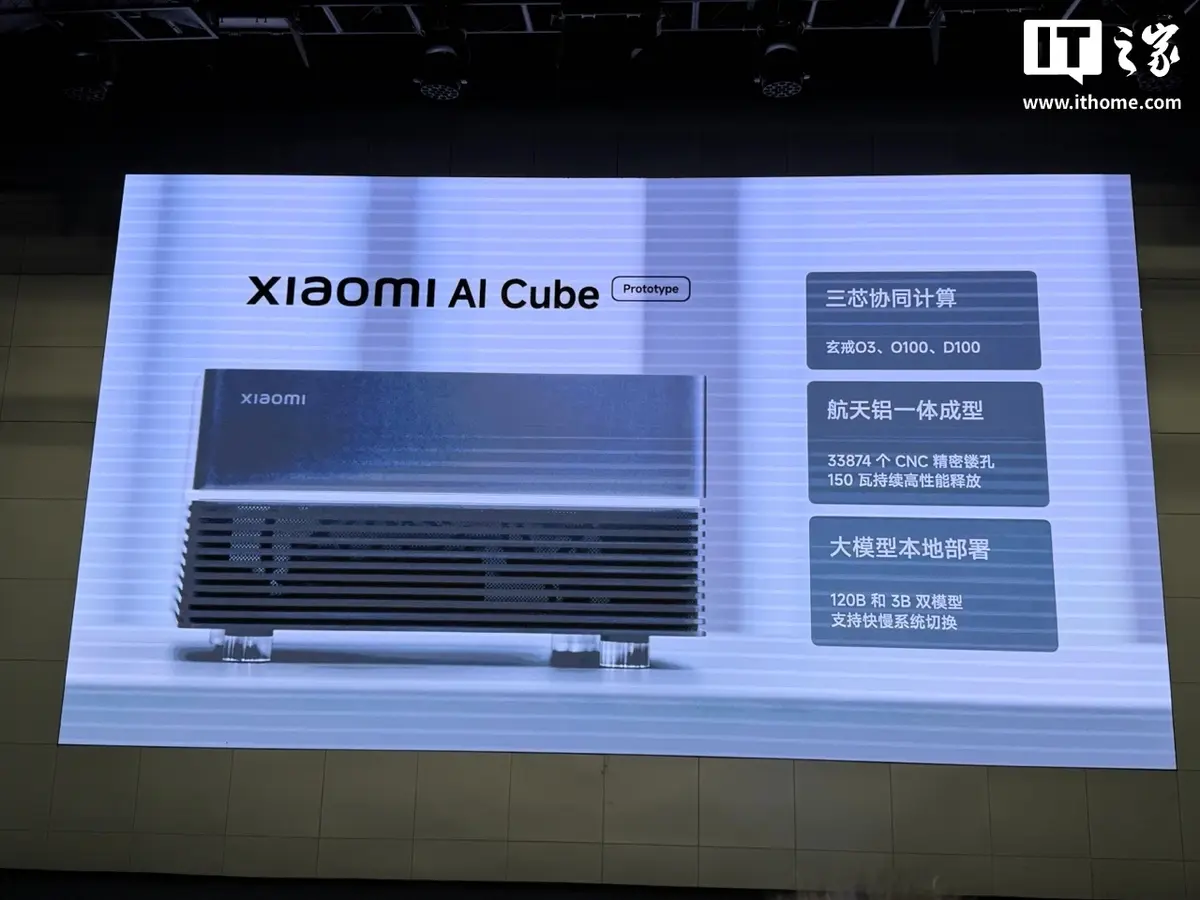
Xiaomi has shown off an ambitious mini PC prototype that puts three of its in-house Xring chips in the same box, aiming to run genuinely large AI models locally rather than handing every clever thought to the cloud.
The Xiaomi AI Cube Prototype combines the Xring O3, O100 and D100 in a three-chip design intended for local large-language-model deployment. Xiaomi has not announced a consumer price or release date.
Three chips, one very busy box
The Xring O3 acts as the system’s AI-focused flagship SoC, with a 10-core all-big-core CPU, a 16-core G2-Ultra NX GPU and a 200 TOPS low-power NPU.
The Xring O100 is a high-bandwidth AI accelerator using 6nm 3D wafer-level stacked packaging. Xiaomi says it has 28,672 effective data connections and up to 1.22TB/s of near-memory computing bandwidth.
The Xring D100 is an AI chip originally aimed at high-compute intelligent-driving workloads. It uses a 3nm process, a 20-core high-performance CPU and a 16-core high-compute NPU, with support for up to 160GB of memory.
Built for local AI
Xiaomi says the AI Cube can deploy 120B and 3B models locally, with support for switching between fast and slow system modes. The 120B figure is notable: that is a model scale well beyond the lightweight assistants usually squeezed into laptops and phones.
Local processing means prompts and files can stay on the machine instead of travelling to a remote data centre. It also avoids the awkward moment when a cloud service decides your monthly allowance has evaporated because you asked it to summarise one slightly long PDF.
The prototype is rated for up to 150W of sustained performance. Its aerospace-grade aluminium enclosure uses a one-piece CNC process and contains 33,874 precision-cut ventilation holes to keep the three-chip arrangement from cooking itself.
A prototype, not a product launch
Xiaomi has presented the AI Cube as an engineering prototype. The company has not yet announced its final specifications, retail price, availability or launch date.
That distinction matters. Prototype demonstrations are useful indicators of what a company is trying to build, but they do not tell us how much the finished machine will cost, how loud it will be, how much memory it will ship with or whether the software experience will be ready for ordinary users.
Our opinion
The AI Cube is an intriguing piece of silicon theatre. Putting a mobile SoC, a dedicated AI accelerator and a high-compute chip together suggests Xiaomi is thinking beyond the usual tiny neural-processing engine bolted onto a conventional mini PC.
The 120B local-model claim is the headline, but the more important question is efficiency. A 150W box is hardly a pocket assistant, and buyers will want to know whether that power budget produces useful speed or merely an impressive specification sheet with a small fan screaming behind it.
Still, local AI needs hardware that can handle more than toy models, particularly for companies and creators who do not want sensitive material sent to a cloud provider. Xiaomi has not turned the AI Cube into a retail product yet, but this prototype shows the company is taking that market seriously.
For now, it is a promising engineering demonstration rather than something you can put in your shopping basket.